
Happy Monday! Five days into Russia’s assault, Ukraine is still holding strong, and the world’s position against the Kremlin is hardening. Let’s get to the news.
Quick Hits: Today’s Top Stories
President Vladimir Putin ordered Russian nuclear forces on high alert on Sunday in response to a weekend of what he deemed “aggressive” NATO statements and hard-hitting economic sanctions. Intense fighting and shelling continued in cities across Ukraine, with Russians making some gains in the South while Ukrainian defense forces persisted in “frustrating” Russian efforts in Kyiv, Kharkiv, and Chernihiv. As we hit send on this newsletter, Ukrainian and Russian officials were beginning to meet for peace talks near the Pripyat River on the border of Belarus and Ukraine. According to U.S. and British defense officials, Russian forces have yet to take control of a major city despite committing about two-thirds of their amassed troops and firing over 300 missiles.
A lot more weaponry is headed to Kyiv, with President Joe Biden approving on Friday the release of up to $350 million worth of military aid to Ukraine. Germany followed suit on Saturday, reversing a decades-old policy of not sending weapons into war zones by issuing 1,000 anti-tank weapons and 500 Stinger anti-aircraft defense systems to Ukraine, as well as authorizing the Netherlands and Estonia to send German-controlled RPGs and howitzers. On Sunday, the European Union agreed to provide Ukraine with approximately €500 million worth of arms.
President Biden announced on Friday his intent to nominate Judge Ketanji Brown Jackson, currently a judge on the U.S. Court of Appeals for the D.C. Circuit, to fill the Supreme Court vacancy left by Justice Stephen Breyer’s impending retirement.
In the wake of most states and localities loosening their own COVID-19 restrictions, the Centers for Disease Control on Friday updated the benchmarks it uses to determine its guidance on masking and other pandemic interventions. The new framework—which the CDC says applies to schools, but not yet public transportation—incorporates a community’s hospital capacity in addition to its case counts, and currently recommends masking for only about 30 percent of the country.
Two days after the CDC guidance was released, New York Gov. Kathy Hochul announced the state would do away with its school mask mandate, beginning Wednesday, March 2.
The Federal Reserve’s preferred measure of inflation, the personal consumption expenditures (PCE) price index, increased 6.1 percent year-over-year in January, the Bureau of Economic Analysis reported Friday. The measure was up from 5.8 percent in December, and at its highest level since 1982.
The U.S. Embassy in Moscow on Sunday urged U.S. citizens in Russia to consider departing “immediately” because an increasing number of airlines are canceling flights into and out of the country.
The South Korean military reported Sunday that North Korea launched another ballistic missile off its east coast on Sunday, its eighth such test this year. North Korean state media claimed the launch was related to its development of a reconnaissance satellite.
Johnson & Johnson, AmerisourceBergen, Cardinal Health, and McKesson have agreed to pay U.S. states a total of roughly $25 billion over the next two decades or so to settle thousands of lawsuits over the companies’ role in the opioid epidemic.
Republican Sen. Jim Inhofe of Oklahoma, 87, announced on Friday he will retire from the Senate at the end of this year, despite being reelected for a six-year term in 2020. He endorsed his chief of staff, Luke Holland, in what will likely be a crowded GOP primary.
The West Gets Serious About Russia Sanctions
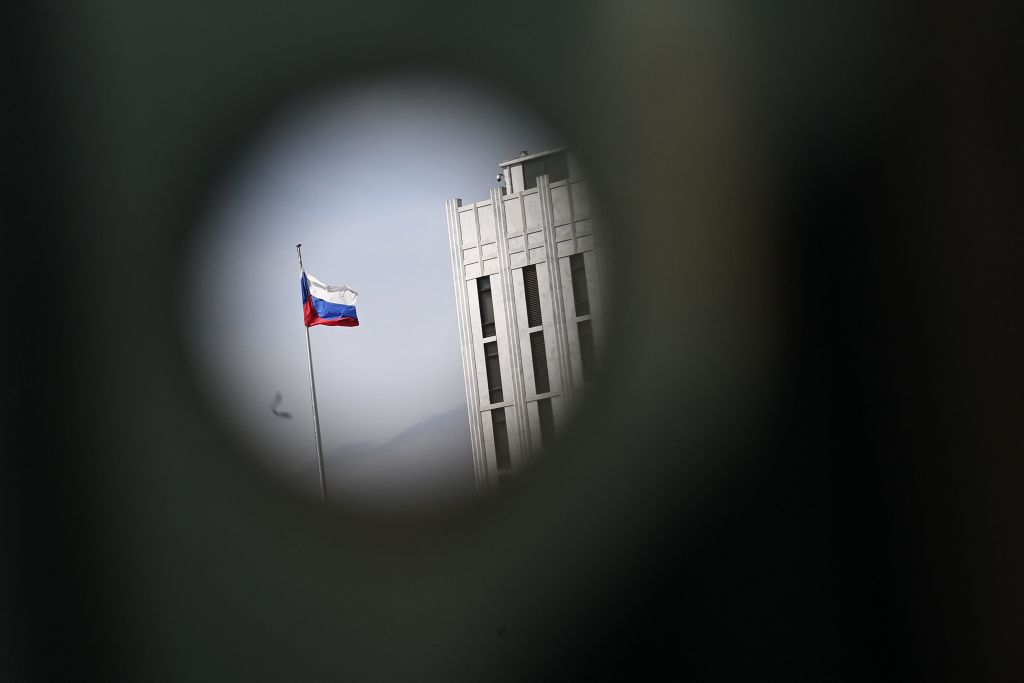
Turns out the West just needed a little kick in the pants.
After months (and really, years) of failing to treat the threat emanating from Russia with the seriousness it deserved, the democratic world—simultaneously horrified and inspired by the images coming out of Ukraine—flipped a switch over the weekend, ratcheting up pressure on Moscow in ways previously considered unimaginable.
Want to see more of The Dispatch in Google search?
Add Us as a Preferred Source


