
The world has changed. Early Thursday morning, Russian television aired a speech from President Vladimir Putin in which he declared he had “decided to conduct a special military operation” in Ukraine. The invasion began shortly thereafter.
Quick Hits: Today’s Top Stories
Putin claimed in his speech the invasion was aimed at “demilitarizing and de-Nazifying Ukraine,” and that Russia has “no plans to occupy Ukrainian territory.” But Ukrainian Foreign Minister Dmytro Kuleba categorized the move as a “full-scale invasion,” with “peaceful Ukrainian cities under strike.” Sources on the ground reported missile strikes and shellings in several cities across the country—including Kyiv—and the Russian military confirmed it was striking Ukraine’s military airfields and air defense facilities. Ukrainian officials said Russian troops have crossed the border from Crimea, Russia, and Belarus, and that there have already been “hundreds of casualties.”
Ukrainian President Volodymyr Zelensky announced he was imposing martial law throughout the country, and encouraged citizens to “keep calm” and “stay at home if you can.” Ukraine began conscripting reservists between the ages of 18 and 60 on Wednesday, and its Parliament voted yesterday to approve a law allowing all civilians to carry firearms and act in self defense. Oleksiy Danilov, secretary of Ukraine’s National Security and Defense Council, called for a 30-day, nationwide state of emergency yesterday that, if approved by Parliament, would allow the government to restrict transportation, implement curfews, and impose additional security measures.
After waiving them last year because they “risked undermining a critical alliance with Germany,” President Joe Biden announced Wednesday the United States would reimpose sanctions on the entity and corporate officers behind the Nord Stream 2 pipeline in response to Russia’s aggression in Ukraine. Sen. Ted Cruz praised the decision and said he would lift the hold on State Department nominees he had implemented in response to the initial waiving.
Canadian Prime Minister Justin Trudeau announced Wednesday he was revoking his government’s use of the Emergencies Act that had been used to disperse anti-mandate protesters in Ottawa over the past week. The House of Commons had voted Monday to allow the measure to remain in place through mid-March, but Trudeau said yesterday the “situation is no longer an emergency.” Finance Department officials said the government had begun unfreezing the more than 200 bank accounts related to the protest that had been restricted.
The Centers for Disease Control updated its COVID-19 vaccine guidance on Tuesday, noting that an eight-week interval between the first and second doses may be “optimal” for males ages 12 to 39 to reduce the “small” risk of myocarditis associated with the mRNA vaccines. The agency said the currently authorized three-week interval for the Pfizer-BioNTech vaccine and four-week interval for the Moderna vaccine remain “safe and effective,” and should still be utilized by older and immunocompromised individuals.
Defense Secretary Lloyd Austin on Wednesday approved requests from D.C. and Capitol Police for National Guard support in advance of a potential Canadian-style trucker convoy en route to Washington, D.C. for President Joe Biden’s State of the Union address next week. Up to 700 unarmed members of the National Guard will deploy from February 26 through March 7 to aid with “traffic control.”
The New York Times reported Wednesday that two prosecutors leading the Manhattan district attorney’s investigation into former President Donald Trump and his business practices resigned yesterday after the district attorney, Alvin Bragg, expressed doubts about moving forward with the case.
Russia Launches War on Ukraine
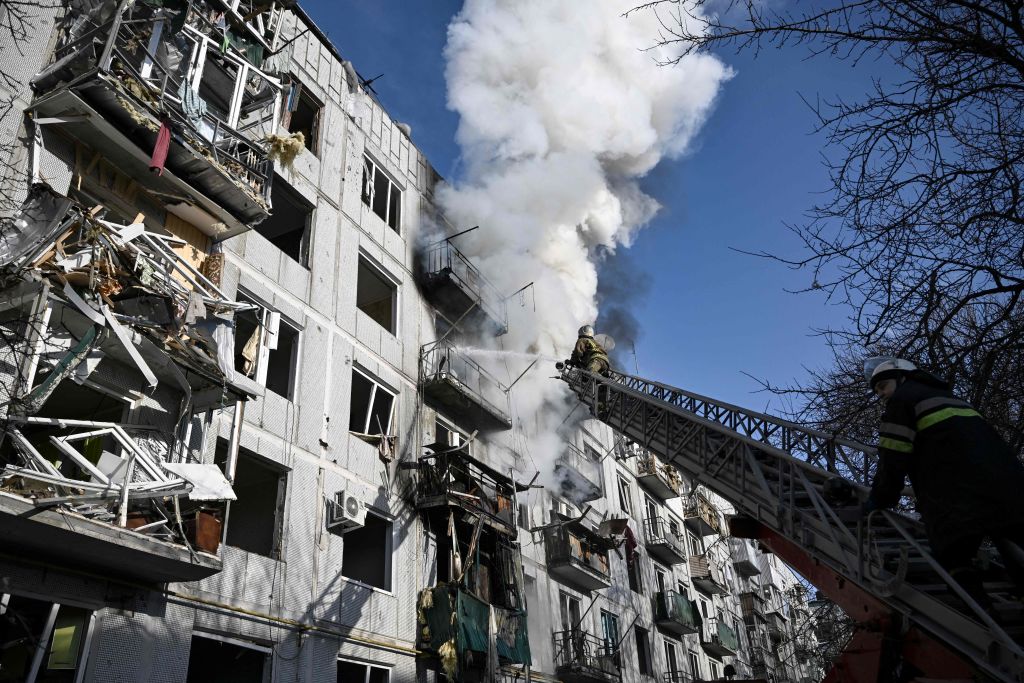
From the moment Russia began to amass tens of thousands of troops along its border with Ukraine last April, a full-scale invasion of the former Soviet republic became a distinct possibility.
Want to see more of The Dispatch in Google search?
Add Us as a Preferred Source


