
Happy Thursday! Opening Day is here; hope springs eternal!
Quick Hits: Today’s Top Stories
In response to alleged atrocities in Bucha, the Biden administration on Wednesday announced a new package of sanctions targeting Russia. The United States will prohibit Americans from making new investments in Russia, implement full blocking sanctions (with carveouts for energy) on two of Russia’s largest financial institutions (Sberbank and Alfa Bank), restrict Russia from making debt payments “with funds subject to U.S. jurisdiction,” and sanction Vladimir Putin’s children, Sergei Lavrov’s wife and daughter, and members of Russia’s Security Council.
The Justice Department announced Wednesday it had charged Russian oligarch Konstantin Malofeyev with violating U.S. sanctions put in place after Russia’s annexation of Crimea in 2014. FBI Director Christopher Wray added that U.S. law enforcement detected and disrupted a global botnet controlled by the Russian military intelligence agency, removing malware from thousands of devices “before it could do any harm.”
President Joe Biden announced Wednesday his administration would extend the pause on federal student loan repayments—first put in place by the Trump administration in March 2020—until August 31. Biden had already prolonged the moratorium in August 2021 (which he claimed at the time would be the final extension) and in December 2021. The Department of Education said yesterday it would also allow those with paused loans to receive a “fresh start” on repayment by “eliminating the impact of delinquency and default and allowing them to reenter repayment in good standing.”
The Federal Reserve on Wednesday released minutes from its March policy meeting revealing board members plan to “expeditiously” move monetary policy to a “neutral” posture by reducing the central bank’s balance sheet by $95 billion a month. According to the notes, many meeting participants believed it “could be appropriate” in the near future to hike interest rates in larger increments than March’s 0.25-percentage-point increase.
Israeli lawmaker Idit Silman announced Wednesday she is leaving Prime Minister Naftali Bennett’s governing coalition. The move deadlocks the Knesset—Israel’s parliament—at 60 seats apiece for Bennett’s government and the opposition coalition, meaning the government will require opposition support to advance legislation. One more defection would allow the opposition to dissolve the Knesset and call for a new election.
U.S. chipmaker Intel announced Tuesday that, effective immediately, it was suspending all business operations in Russia in response to the war in Ukraine.
GOP Rep. Bob Gibbs of Ohio announced Tuesday he will retire at the end of his current term after 12 years in Congress, blaming his state’s “circus” redistricting process, which significantly reshaped his voter base and is still facing legal challenges. He would have had to face a primary challenge from Max Miller, a former Trump administration staffer backed by the former president.
The House voted 220-203 on Wednesday to hold two former Trump aides—Peter Navarro and Dan Scavino—in contempt of Congress for refusing to comply with subpoenas from the January 6 Select Committee. It remains to be seen whether the Department of Justice will act on Congress’ referral. Steve Bannon was indicted following a contempt of Congress vote, but former Trump Chief of Staff Mark Meadows has thus far not been.
Brian Kolfage—the Air Force veteran accused of defrauding Trump supporters by crowdfunding money to “build the wall” along the U.S.-Mexico border—has agreed to plead guilty to wire fraud conspiracy and multiple tax charges, according to a Justice Department filing.
U.S. Promised to Welcome 100,000 Ukrainians. Can We?
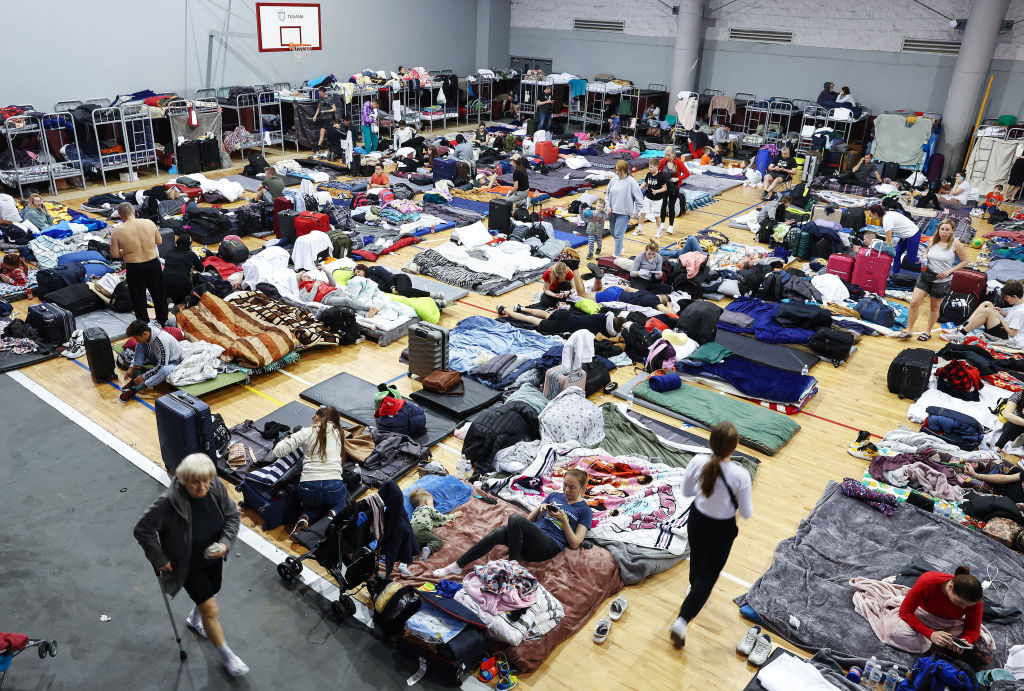
President Joe Biden announced March 24 that the U.S. will welcome up to 100,000 Ukrainians displaced by Russia’s invasion. The plan is popular—seven in 10 Americans, including 57 percent of Republicans, supported admitting “thousands” of Ukrainian refugees in a mid-March Pew Research Center poll—but the administration’s been slow to fill in the details.
Want to see more of The Dispatch in Google search?
Add Us as a Preferred Source
Declan Garvey is the publisher of The Dispatch and is based in Washington, D.C. Prior to joining the company in 2019, he worked in public affairs at Hamilton Place Strategies and market research at Echelon Insights. When Declan is not assigning and editing pieces, he is probably watching a Cubs game, listening to podcasts on 3x speed, or trying a new recipe with his wife.


